- MOTIVSPRINT
- Posts
- Your Guide to Glycogen-Depleting Workouts and Refeed Strategies
Your Guide to Glycogen-Depleting Workouts and Refeed Strategies

Lyle Agagon
January 29, 2026
EXERCISE 🏋️♂️

Are you looking to break through a fitness plateau? Maybe you want to get leaner, improve your endurance, or feel stronger during your workouts? If so, then you might want to try "depletion" and "carb loading" strategies. They revolve around your body's primary fuel source: glycogen.
Your Body’s Gas Tank
Your muscles need fuel. Their main fuel for high-intensity exercise is called glycogen. Glycogen is simply stored carbohydrate.
When you eat carbs like bread, pasta, rice, or fruit, your body breaks them down into sugar (glucose). This sugar enters your bloodstream for immediate energy. Any extra sugar gets packed up and stored in your muscles and liver. This stored form is glycogen.
Your muscles hold most of this glycogen. It is your ready-to-use energy reserve for activity. When you sprint, lift weights, or play sports, you burn through this glycogen. A full "gas tank" of glycogen helps you train harder and longer. An empty tank makes you feel sluggish and weak. Managing this tank is the key.
Glycogen-Depleting Workout
A glycogen-depleting workout is a specific type of training. Its sole purpose is to use up, or "deplete," the stored glycogen in your muscles. It empties your gas tank on purpose. This is different from a regular workout. A regular workout uses some glycogen, but likely not all of it. You finish tired, but not completely empty.
A true depletion workout is longer and more challenging. It involves high volume. This means you do many sets and repetitions of exercises. The goal is to keep your muscles working continuously. You do this until they have very little fuel left. It is a deep, intentional fatigue.
The Simple Science Behind Depletion Workout
Your muscles need energy to work. Their favorite quick energy comes from glycogen, which is stored fuel. When you do a very long and hard workout, your muscles use up this stored fuel.
After about 60-90 minutes, your fuel tank gets very low. When this happens, your body gets a signal. It learns and adapts so it can perform better in the future. This is where the benefits come from. Also, with its main fuel low, your body may start to use stored fat for energy instead.
Benefits and Drawbacks
Potential Benefits:
Shock Your System: It can help you break through a fitness plateau.
Better Definition: After emptying, refilling muscles can make them look fuller and more defined.
Teach Your Body: It can train your body to use fat for fuel better, which helps endurance.
Increased Insulin Sensitivity: After depletion, your muscles are eager to absorb sugar and nutrients. This can make your body handle carbs more effectively.
Potential Drawbacks:
Very Demanding: These workouts are extremely tough physically and mentally.
Risk of Overtraining: Doing them too often can lead to injury, burnout, and weakened immunity.
Not for Everyone: Beginners, people with certain health conditions, or those with poor recovery habits should avoid them.
Temporary Weakness: Your performance in other workouts that week may suffer due to deep fatigue.
How to Perform a Glycogen-Depletion Workout
Timing: Do this workout before a planned high-carb day or refeed. Many people do it on a Friday or Saturday.
Structure: Focus on one or two major muscle groups per session (e.g., Legs & Back). Do not try to deplete your whole body at once.
The Plan:
Choose 3-4 exercises for the target muscle group.
Perform 4-5 sets of each exercise.
Aim for 15-20 repetitions per set. The weight should be challenging but not maximum.
Keep rest periods very short, about 45-60 seconds between sets.
The entire workout should last 60-90 minutes. You should feel completely drained by the end. Your muscles will feel like they have nothing left to give.
The key is constant work with light-to-moderate weight and high reps. Do not go to failure on every set early on. Pace yourself to complete the entire high-volume plan.
The Refeed Strategy
A refeed strategy is the planned follow-up to a depletion. It is not a "cheat day." It is a strategic increase in carbohydrate intake. The goal is to replenish your emptied glycogen stores. Think of it as filling your gas tank back up after a long drive.
When your muscles are empty, they are like a dry sponge. They soak up carbs and store them as glycogen very well. This refilling process can boost your energy and metabolism.
How to Do a Refeed
Timing: Start eating more carbs within a few hours after your depletion workout. Your refeed day should be a rest day or a very light activity day.
Food Focus: Eat more carbs. Keep your protein the same as a normal day. Eat a little less fat for this one day.
Good Carb Choices: Oatmeal, sweet potatoes, white or brown rice, quinoa, fruit.
Avoid: Sugary drinks, candy, and heavy junk food. These can make you feel sick and bloated.
Simple Refeed Plan:
On a normal day, you might eat 150 grams of carbs.
On a refeed day, eat 250-300 grams of carbs.
Spread these extra carbs over 3-4 meals.
Sample Refeed Meal: Baked salmon, a large baked sweet potato, and green beans.
The next day, you should feel energized and strong. Go back to your normal, healthy eating.
Glycogen Strategy Is A Tool
This strategy is about managing your body's fuel, called glycogen. First, you do a very hard workout to empty your fuel tank. Then, you eat more healthy carbs to fill it back up. This can help you get past a fitness plateau or improve your endurance.
But this is a tough and advanced method. It is not for beginners or for people with health problems. It is not something you should do often.
The most important things for your fitness will always be the basics. Eat well, exercise regularly, get good sleep, and manage stress. That strong daily routine is what really works. This glycogen strategy is just one extra tool you might try much later, once you have mastered the basics.
NUTRITION 🥑
The Blood Sugar Trick That Protects Lean Muscle

Fiber. It’s the stuff in plants that keeps you, well, regular. But eating fiber first in a meal is a powerful trick. This one move does two critical things: it keeps your blood sugar steady, and it acts as a bodyguard for your muscles.
The Carb Problem
We all eat carbohydrates. When we digest them, they turn into sugar (glucose) in our blood. Our bodies use this sugar for energy. But the problem is that a big, fast spike in blood sugar isn’t good.
When your blood sugar spikes high and fast, your body panics. It releases a hormone called insulin to quickly pull that sugar out of your blood. Often, that extra sugar gets stored as fat. Worse, these spikes and crashes leave you tired, hungry, and craving more sugar soon after.
This rollercoaster is also bad for your muscles. To build or even just maintain lean muscle, your body needs to be in a “building” state. Constant blood sugar spikes create inflammation and hormonal signals that can tell your body to break down muscle for energy instead.
The “Fiber-First” Trick
When you sit down to eat, start with the fiber-rich foods on your plate before you touch the carbs or even the protein.
What are these fiber-first foods? Think vegetables (like broccoli, salad, carrots, peppers), legumes (like beans and lentils), and whole fruits. A simple rule: start with the greens and beans, then move to the rest.
Why This Order Works
Fiber is a Speed Bump. Soluble fiber, found in foods like oats, beans, apples, and Brussels sprouts, turns into a gel in your gut. This gel creates a barrier. When the carbs from your meal hit this barrier, their breakdown slows down. Absorption stalls. Everything moves at a steadier pace.
No Spike, No Panic. Because the carbs are absorbed slowly, the sugar enters your bloodstream like a gentle trickle, not a tidal wave. Your body doesn’t need to panic-release a flood of insulin. It uses a calm, measured amount.
Your Muscles Get a Steady Supply. With steady blood sugar, your muscles receive a reliable drip of energy they can use over time. Your body never gets the signal to break down muscle for fuel. Stable insulin also helps your body use protein more efficiently for muscle repair and growth.
It’s not a diet. You’re not cutting anything out. You’re just changing the order in which you eat the food already on your plate.
How to Start Tonight
Your dinner plate probably has a protein (chicken, fish, tofu), a carb (potato, rice, pasta), and vegetables. Instead of digging into everything at once:
First: Eat your vegetables or salad. Finish most of them.
Next: Move to your protein and healthy fats.
Finally: Enjoy your carbohydrates.
You’ll still eat all the same foods and calories. But you’ve just changed your body’s entire response to the meal.
Try It
At your next meal, just start with the fiber. The benefits are huge. You’ll feel fuller longer, have more stable energy, and cut those annoying cravings. Most importantly, you’re protecting the metabolic engine of your body, your lean muscle. Muscle burns calories even at rest and keeps you strong and active for life.
BIOHACKING⚡
Giving Your Cells a Better Fuel Mix
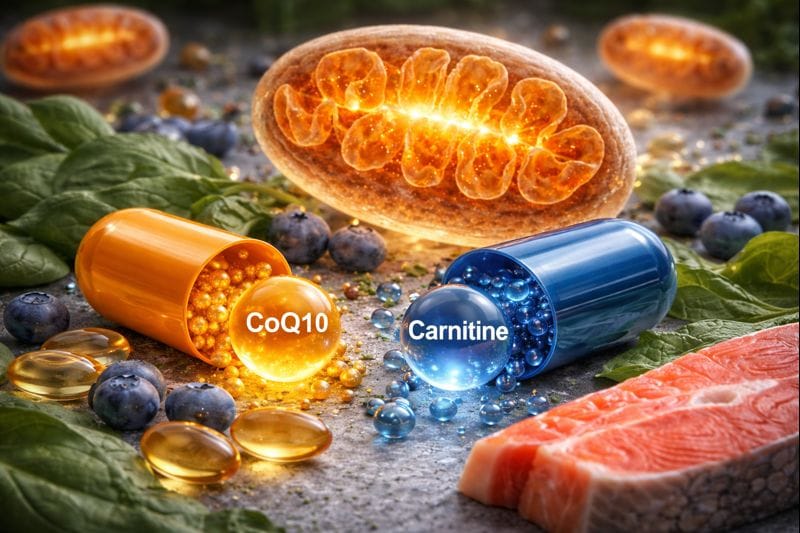
Let’s talk about energy. Not the caffeine jolt of energy we sometimes think about. The cellular energy that keeps your heart beating, your brain thinking, and your body moving. That energy is produced by cells called mitochondria.
Mitochondria are small structures inside most cells. Their job is to convert food and oxygen into ATP (adenosine triphosphate). ATP is the body’s usable energy source. Higher ATP production allows the body to function more efficiently.
When mitochondria are stressed, damaged, or underperforming, energy levels drop. Common signs include fatigue, slow recovery, and mental fog.
Mitochondrial nutrient stacking focuses on supporting this energy system. Stacking means combining nutrients that work together on the same process. Two key nutrients used for this purpose are CoQ10 and carnitine.
CoQ10: The Energy Production
Inside your mitochondria, there’s a process called the "electron transport chain." CoQ10 is essential here. It helps move electrons during ATP production, which allows energy to be created efficiently. CoQ10 also acts as an antioxidant inside the mitochondria. It helps clean up waste created when energy is made.
Your body makes CoQ10 naturally, but production starts to drop as we age. Also, some medications (like certain cholesterol drugs) can lower your levels. Low CoQ10 means the energy output is weaker.
Carnitine: The Fuel Transporter
One of the best fuels for your mitochondria is fat. It provides steady, long-lasting energy. But fat can’t enter the mitochondria on its own. That’s where carnitine comes in.
Carnitine’s main job is to transport fatty acids into the mitochondria so they can be burned for clean, long-lasting energy. Without enough carnitine, the fat just sits outside, and your mitochondria have to use less efficient fuels. It's like having a huge pile of premium firewood, but no one to carry it into the furnace.
The 1-2 Punch
Taking these two together makes sense because they support different, but connected, parts of the same process.
Carnitine delivers fuel to the mitochondria
CoQ10 helps convert that fuel into ATP
It’s a perfect partnership. Carnitine makes sure the fire is stocked with good wood, and CoQ10 makes sure the fire burns bright and clean. One improves fuel supply, the other improves energy production. This approach addresses the entire energy process rather than one part of it.
Who Might Think About This Stack?
People often look into this stack if they:
Feel a general, unexplained fatigue that sleep doesn’t fix.
Are getting older and want to support their cellular health.
Have heavy exercise routines and want to improve recovery.
Take medications known to lower CoQ10 levels.
Important Things to Know Before You Start
Talk to Your Doctor First. This is crucial. They can help you figure out if it's right for you, check for interactions with any medications, and suggest a proper dose.
Food Sources: You can get small amounts from food. CoQ10 is in organ meats, fatty fish, and spinach. Carnitine is in red meat and dairy. But to get to "stacking" levels, people often use supplements.
Quality Matters: Supplements are not all created equal. Look for trusted brands. For CoQ10, the form called "ubiquinol" is often considered more absorbable, especially for people over 40.
It's Not Instant. This is about repairing and supporting tiny cellular engines. It’s not like caffeine. Give it a few weeks to notice a difference, if you’re going to notice one at all.
The Bottom Line
Mitochondrial nutrient stacking with CoQ10 and carnitine goes straight to the source of your energy. One improves fuel delivery. The other improves energy production.
When your mitochondria work better, everything else tends to follow. Think of it as basic maintenance for the engines that run your body.
🧠 You’re Adding Years to Your Life—Are You Adding Years to Your Money?

You train to stay strong.
You eat to stay healthy.
You plan your life around longevity.
But most people miss this part:
Living longer changes the rules for money.
A longer life can mean more healthcare decisions, more years without a paycheck, and more pressure on savings to last. That’s not a problem—it’s just something that needs planning.
That’s why some health-focused people use Index Universal Life (IUL) as part of their long-term strategy. Not to chase returns. Not to time the market. But to create a layer of protection and flexibility for the future.
With IUL, people use this approach to:
Protect their family
Build flexible money that they can access later
Reduce stress around the “what if” years
This is about options. Not pressure.
👉 Curious if this fits your longevity plan?
Reply “LONGEVITY” and I’ll send you a short, plain-English guide.
CHALLENGE💪
Your Challenge of the Week: The "Veggies-First" Experiment

For the next seven days, do this:
Identify the fiber: Look at your plate. Find the vegetables, salad, or beans.
Eat them first. Finish at least half of these fiber-rich foods before you take a single bite of your protein or carbohydrates (like rice, bread, or potatoes).
Then, eat the rest of your meal normally.
That’s it. No other rules. No banned foods.
Your goal is simple: Notice what happens. Do you feel fuller faster? Do you have fewer energy crashes or cravings an hour later? Just observe.
This small change in sequence is the entire "blood sugar trick." By the end of the week, it won't feel like a challenge—it'll just feel like how you eat. Your muscles (and your energy levels) will thank you.
QUOTE OF THE WEEK 💬
“The vision of a champion is bent over, drenched in sweat, at the point of exhaustion, when nobody else is looking.” —Mia Hamm

REWARDS 🥇
MERCH 👕

 Janelle: Women’s Tee |  Patrick: Coffee Mug |
 Melissa: Unisex Hoodie |  Rodney: Trucker Hat |
Spread the Word!
If you found this content informative, thought-provoking, entertaining, enjoyable, life-saving, or simply awesome, don’t be greedy! Share. It’s FREE!

Reply